
How to Learn BJJ Faster: 3 Principles That Changed the Way I Train
If I were to restart BJJ today, here are the learning principles I'd learn to progress faster.


When someone asks me how they can get better ‘faster’ at BJJ, my answer is usually: ‘the same way you get better at anything else’. There is no jiu-jitsu-specific cheat code. The answer is the same in BJJ as it is in any other discipline: get better at learning.
Learning, in itself, is a skill. Become an elite learner, and you’ll be able to acquire other skills faster. Most of what I write is really meant to help people get better at learning jiu-jitsu, rather than just providing instructional material or one-off technique tips.
It’s the old ‘teach a man to fish’ principle, which makes me much more interested in teaching people how to learn, rather than what to learn.
Remember, jiu-jitsu isn’t a videogame; it’s an art. I define ‘art’ as any medium of self-expression, and you have to practice your art for a really, really, REALLY long time until you can begin to express yourself through it. Learning is the skill that helps us close that gap.
Here’s what I see as the three most important learning principles for increasing progress in jiu-jitsu (and everything else).
Principle 1: Feedback loops
Learning has certain ‘laws’ which are immutable. Like the laws of physics, you can’t change them; only discover them.
If learning had a root law, it would be feedback loops. Think of feedback loops as the underlying engine of any progress. They’re the ground zero of learning. If you’re trying to improve your jiu-jitsu and feel like you’re stagnating, the chances are your feedback loop is broken.
But let’s get specific. When I say ‘feedback loop’, I’m referring to what Donella Meadows describes as ‘reinforcing feedback loops’ in her book ‘Thinking in Systems’. In Meadows’ words:
“[A reinforcing] feedback loop is amplifying, reinforcing, self-multiplying, snowballing - a viscous or virtuous circle which can cause healthy growth or runaway destruction.”
Donella Meadows, Thinking in Systems
Put simply, a reinforcing feedback loop is anything that grows by a fraction of itself over time:
You practice guitar, which makes you better at guitar, which makes you enjoy it more, which makes you practice for longer.
You save money, which grows your balance, which earns you more compound interest, which adds to your savings.
I write this Substack because I enjoy having more people give feedback on my work, which means I write more, which means more people subscribe and read it, which brings more feedback…
And so on.
Start by Setting Up Practice Loops
In BJJ, the first type of feedback loop you want to build is one that allows you to increase your practice time.
When you first start BJJ, you won’t have the physical conditioning or technical understanding to train for too long, and you need to fix this before you can get into any deeper learning.
I’ve trained jiu-jitsu for a long time, but even for me, if I’m out of shape, the first step is to condition myself so I can train more often and start making the breakthroughs you can’t make on 1-2 sessions per week.
When I’m learning a new skill - like guitar - I need to take even smaller steps. My fingers aren’t conditioned enough for anything more than 15-20-minute practices at the moment. But if I keep practising simple two-chord songs for long periods, my fingers will become more conditioned, allowing me to practice more.
Practice begets practice. So, before anything else, create the conditions which allow you to practice more. Over time, the duration - or frequency - of your training sessions will increase, and your learning will compound.
Once you’ve got your practice loop whirring, the next stage is to make sure each practice is optimised so you are making clear 1% improvements with each session.
Principle 2: Use Constraints for Deliberate Practice
In the 1990s, Swedish Psychologist K. Anders Ericsson assembled a bunch of violinists at Berlin University of the Arts. He wanted to see if there was something which powered elite performers beyond mere talent.
His famous ‘Violin study’ separated violinists into three groups: future music teachers (average performers), good performers and elite performers. Then he studied whether there was any difference in their practice habits. By the age of 20:
Future music teachers averaged around 4,000 hours
Good performers averaged around 8,000 hours
Elite performers averaged roughly 10,000 hours
In later years, this study would inadvertently give rise to the 10,000-hour rule - but the point was never the volume of hours put in. Ericsson found it was even more about how they practised. He said that all the elite performers engaged in something he named ‘Deliberate practice’.
Deliberate practice has a few specific traits, including that the sessions are:
Guided by a clearly defined goal
Provides immediate feedback on performance
Relies on repetition and refinement
Pushes the performer beyond their comfort zone
Involves continuously identifying and correcting mistakes
Like elite violinists, learning Law 1 means you’ve set the conditions to put in the hours. But we also need to learn from the way these elite performers went to every practice with something specific to work on and constantly worked at the edge of their ability.
Deliberate practice is about using voluntary constraints on your practice to tighten the feedback loop. You might hear the word ‘constraint’ and think it sounds restrictive, but its real function is to force you into more productive exploration.
David Epstein has a great book, 'Inside the Box,’ which explains how constraints can be used to boost creativity across business, sport and art. He has a great analogy, describing the constraints you set (he suggests many of the same as those Ericsson outlines in the violin study) as similar to the bumpers in a bowling alley.
Learning to set these guardrails is just as important as what you do in between them. Too much freedom, especially in a sport as complex as jiu-jitsu, can make it extremely difficult to learn.
Two Constraints you can use for deliberate practice
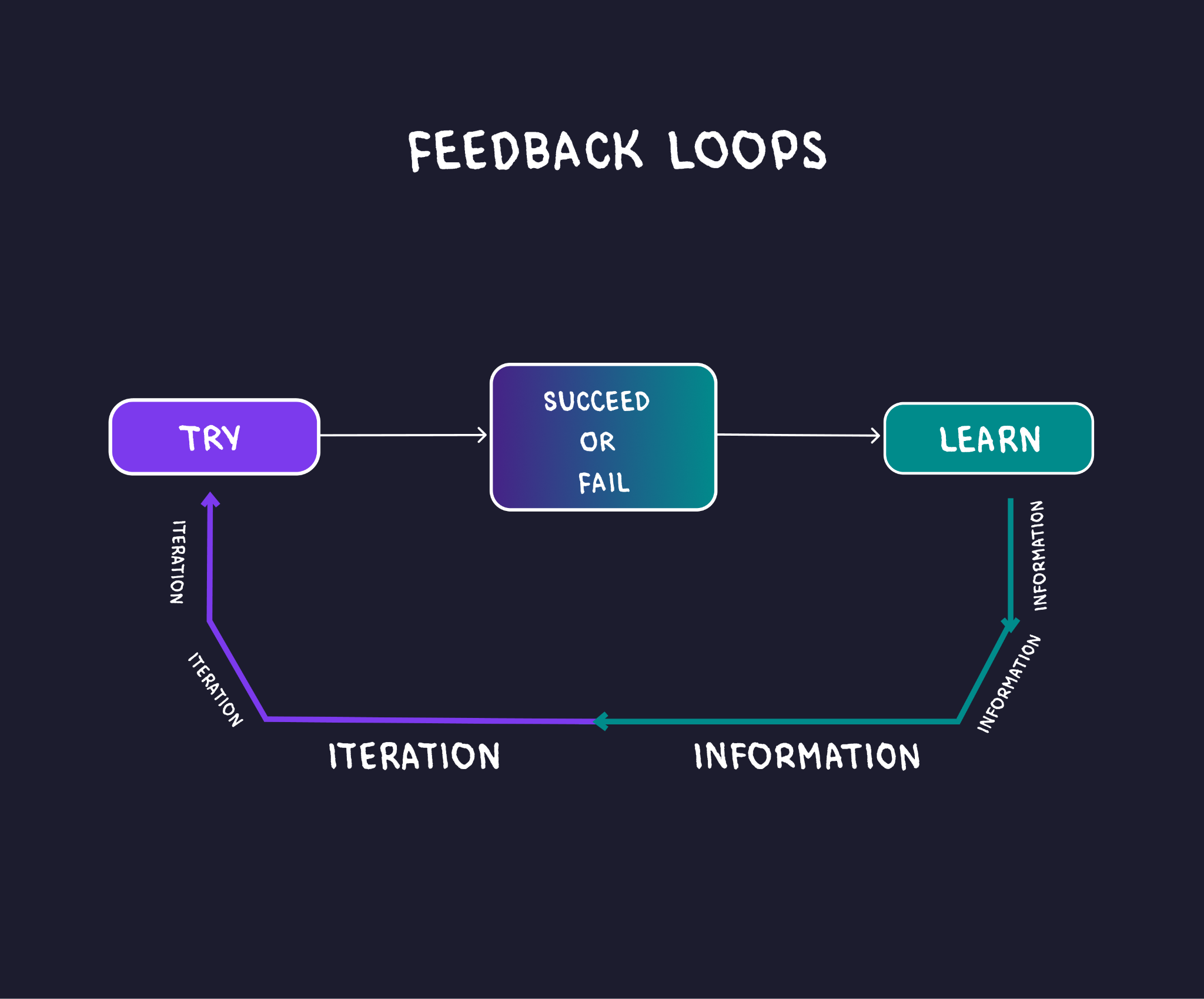
The feedback loop above illustrates some features of deliberate practice. Mainly, the value of two constraints in particular:
1. Having a goal:
Experiments are impossible to run without a thesis. Without deciding what you’re trying to improve or test, it is virtually impossible to see whether something worked or not.
Go to every training session with an intention or objective; something you are focusing on improving. By narrowing the scope of what you’re working on, you can accelerate your experimentation more than someone who goes to training without the same mental parameters.
Your goal or intention will set the starting point for the feedback loop. But then, as you can see in the diagram, your live training will validate or invalidate your thesis. Those errors become information that helps you to set the goal for your next session.
And so on.
2. Training at the edge of your ability:
Ericsson’s found that all the elite violinists spent more time training right at the edge of their ability.
I always think of it as the ‘edge’; the sweet spot between practices that are so easy that you’re stagnating and practices that are so hard you aren’t learning anything. Elite learners find this Goldilocks zone and start experimenting within it relentlessly.
One of the best ways to do this is by training with the right people, which brings us to the third and final law.
Principle 3: Surround yourself with the right training partners
When you get to purple, brown and black belt, you face a real challenge that in many gyms you’ll probably be one of, if not the, highest level grapplers on the mat. It means you can go for years and only occasionally train with people who really push you.
A couple of weeks ago, I was reunited with some old training partners, and we had our first rolls in 6 years. Since I last saw them, many have won medals at the IBJJF brown- and black-belt Europeans.
The rolls were very hard, as you’d imagine with back-to-back brown- and black-belt IBJJF Euros medalists. But having exposure to very high-level training partners also felt like it completely changed what I thought was possible.
It brings me to the final thing to boost your progress: train with the right people.
Find a mentor
First, you need a mentor. This is something that becomes harder the more advanced you become, as you might be in a situation where you travel to gyms and are the most experienced on the mat.
As many of my readers will know, I spent nearly six years just coaching gym to gym with no coach or supervision. While I think there are great benefits for your coaching when you have this independence, the research around the strengths of having mentors to boost your progress is undeniable - in almost every domain.
K. Anders Ericsson, the Swedish Psychologist we referenced earlier, also said this was something the elite violinists had in common. Each had a mentor who could make sure they were always practising at the ‘edge’.
When you think of this logically, it makes sense. You often need someone much higher level than you, or someone who has trained other athletes to a really high level, to help you see where your plateaus are. It’s kind of like having a navigator shout the route down to you from the top of the mountain.
In Ericsoon’s words, this doesn’t just apply to violinists, but nearly every domain:
“These findings are consistent with internationally successful athletes, scientists, and artists, where [Benjamin] Bloom (1985) found that, virtually without exception, each individual had been trained by a master teacher, who had trained earlier students to an international level.”
In jiu-jitsu, don’t judge your mentors by the piece of fabric wrapped around your waist. During my travels, I’ve trained with plenty of black belts who have fragile egos and aren’t high-level in terms of skills. Perhaps these two things are linked.
Instead, judge your mentor on two things and two things only: their integrity and their skills. Believe it or not, it’s not the easiest thing to find people that fit into the middle of that Venn diagram.
But if you do, try and train with them as much as possible and make yourself as coacheable as possible. It’s amazing the leaps you can make in a short space of time with the right mentor. Don’t believe me?
Mike Tyson went from being a 16-year-old in the Bronx to a world champion at 21. He had one of the greatest mentors of all time - Cus D’Amato
Gordon Ryan won his first ADCC gold in 2017, also exactly five years after meeting his mentor John Danaher in 2012
Georges St-Pierre met Firas Zahabi following his loss to Matt Serra at UFC 69 in 2007, and then went on a 12-fight winning streak that lasted over six years.
Obviously, these are amazing athletes. But I also don’t think any of them would have reached the point they did in the space of time they did without an amazing mentor.
Three types of training partner
If you want to progress quickly, you need three types of training partners.
People worse than you: The benefit of training with these people is that you can develop and refine new parts of your offence before you start using them against higher belts.
People at the same level as you: Training with these people is often the closest thing to competition because your similar skill levels tend to cancel each other out, making the way you apply your jiu-jitsu and your tactical decisions more important.
People better than you: This will force you to work on the weaker areas of your game, which is usually your defence, but if someone is miles better than you, you’re probably learning more about survival than skill development.
Now, there are a couple of caveats here.
Caveat #1:
I still think there’s a benefit to training with people who are much better than you. As you reach purple, brown, and black belt, training with people who still school you can raise your psychological ceiling by showing you what’s actually possible.
As I said, this happened recently. I’ve trained for 12 years, so rolling with people who can completely shut me down isn’t just humbling; it also reinforces that there are new levels to work towards.
In MMA and Boxing, this is sometimes referred to as “the rub.” It’s the idea that when you compete or train with an opponent much better than you, you might get beaten - but also something about their level ‘rubs’ off on you.
For example, Stipe Miocic fought a war against Junior Dos Santos, which he lost, but then went on a historic heavyweight run straight after it. I remember Daniel Cormier said he felt it was down to the ‘rub’.
Even if you train with folks who completely shut you down, if it raises your mental ceiling of what you thought was possible - it’s worth it.
Caveat #2:
Going back to Ericsson’s research, we know that training at the edge of your ability is essential to boost progress.
When it comes to training partners, people who are just a little better than you are probably the sweet spot if your goal is to accelerate your development. This is at least what I’ve found in my own development.
Thanks for reading!
Hopefully these principles are helpful to you in your jiu-jitsu journey. Once you know them, the only extra ingredient you need is time.
Elite learners are also lifelong learners, and if you never stop being curious, you’ll go much further than you ever thought was possible.
Will be sharing this one with my team. So good
Amazing insights into development. I agree with the rub of training with those better. When I started , I was in a room with advanced whites , blues and purples . I got demolished but I believe it helped me to develop. It was a sink or swim environment.