
How time and rulesets shape what works in jiu-jitsu (and how to choose what to train)
Why time is the only metric that matters in BJJ, and a framework for choosing techniques based on time and context.


“For the perishable, every additional day in existence implies a shorter remaining life expectancy. For the non-perishable, every additional day may imply a longer life expectancy.”
Antifragile, Nassim Nicholas Taleb
Last week, we looked at how every time you roll in BJJ, it’s like opening a Pandora’s box of mind-boggling complexity.
It’s one of those games where, once you start playing, you’re faced with a universe of options that expands with every decision you make. To avoid getting lost in it, you need filters to decide what is and isn’t worth your attention.
We looked at two ways to reduce the complexity of jiu-jitsu: heuristics and the 80/20 rule.
Heuristics are simple rules of thumb that whittle down an astronomical set of options to something manageable.
The 80/20 rule shows that a small number of a system’s parts (20%) usually create most of the results (80%).
If last week’s piece was about how to focus better because our time on the mat is limited, this one is about how we can use that same constraint to judge which techniques are, and aren’t, truly effective.
Judging techniques in 2D
Most jiu-jitsu practitioners judge techniques based on how high or low percentage they are. If someone says a technique is high-percentage it means it works a lot. If it’s low percentage, it works a little.
You can apply the same logic to competition statistics. A quick Google search will tell you which submissions account for the highest percentage of finishes in BJJ right now.
The problem with using search and statistics to identify the 20% of techniques that do 80% of the work is that BJJ naturally produces a skewed data set.
In a sport that constantly spawns new rule sets, a high-percentage technique under IBJJF rules is unlikely to be the same under EBI, and so on.
More importantly, this kind of analysis usually leaves out what, in my eyes, is the best heuristic for judging whether something really works: time.
Without it, the dataset becomes a snapshot of something that worked at a certain time under a specific ruleset.
Evolution
If you believe in evolution, time is the filter that separates what works from what doesn’t. Everything passes through it.
What works survives and continues on its journey through time; what doesn’t is left behind as a small, forgotten iteration of history.
Shifting your focus from what’s new to what’s survived is one of the most valuable mindset shifts for assessing which BJJ techniques really do the heavy lifting.
When you zoom out on any combat discipline over time, clear patterns appear.
Using time to assess your weaponry
By the late Middle Ages (around the 14th–15th centuries), the rise of full plate armour made traditional slashing swords far less effective.
In response, swords evolved into narrower, more rigid thrusting weapons such as the estoc, designed to slip into gaps at the joints. At the same time, blunt weapons like maces and war hammers became more common because they could transmit force through armour without needing to cut it.
These adaptations were closely tied to the specific era of armour and battlefield conditions.
By contrast, the spear shows up almost everywhere, for almost the entire history of organised warfare:
With Greek hoplites (c. 700–300 BC)
In Roman legions (c. 300 BC–400 AD)
In medieval European armies (pikes and lances, c. 1300–1600)
…and in Asian warfare (the Chinese qiang and Japanese yari, used for centuries)
Some weapons emerged to solve short-term, specific problems. Others endured because they solved basic, universal ones. In the case of the spear, it was controlling distance and delivering force safely.
This essay is about making the same distinction in Brazilian Jiu-Jitsu, separating temporary innovations (the responses to plate armour) from techniques that persist because they work across eras (the spear).
The meta and information advantages
The shape of progress
I always find it strange when I roll with early white belts and see them learning techniques in their first few months that took my training partners and me decades to figure out.
But that’s how progress works. One generation spends years solving a problem, then passes the solution on so the next generation can learn it in a fraction of the time. Writing is a good example. You can take decades of experience and reduce it to marks on a page that someone else can absorb in minutes.
And, just as every word has an etymology, every technique has a lineage. Today’s blue belts stand on foundations built by the black belts before them, and experimentation always starts from that new baseline.
Disruption
From time to time, though, there are short windows where you can spot how the sport is shifting enough to gain an information advantage.
During these periods of change, certain techniques suddenly have an outsized impact on the sport and become especially worth learning.
This is what we refer to as the Meta, literally the Most Effective Tactics Available.
The meta is like the environment the sport lives in. You can get better as an individual, but if you don’t pay attention to how the environment is changing, you’ll eventually fall behind. Ignoring it is like sprinting to a finish line while the ground shifts beneath your feet.
Rulesets shape everything
It’s worth noting that the meta isn’t just the natural result of a sport evolving over time. In BJJ, the constant creation of new rulesets is a major driver of change.
As I mentioned earlier, this makes any objective judgement about which techniques work and which don’t much harder. As the sport fragments into different formats, it also fragments into different specialisms.
In practice, technique evolution in BJJ is shaped by two forces:
Rulesets + time = the meta.
Information advantages
When you track the BJJ meta, you start to notice short windows of opportunity where an innovator introduces a new technique or position. It appears on the world stage, but there is a delay before it spreads through the rest of the sport.
Like any innovation, adoption happens in waves. New techniques move slowly, from the innovators, to the fast followers, and eventually to everyone else.
In BJJ, you may learn what the innovator is doing: the technique or tactic. But the real gap closes only when you understand why it works: the strategy, fundamentals and positional ideas behind it.
In the time it takes you to close the gap between ‘what’ and ‘why’, the innovator will compete with a significant information advantage.
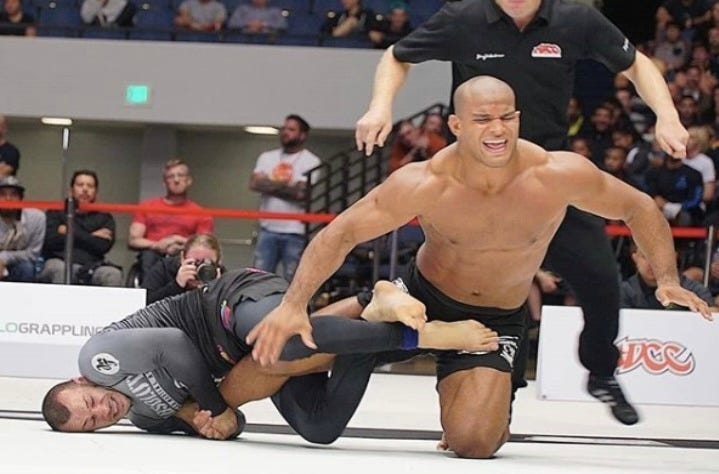
There’s been plenty of evidence over the years of what a large information advantage can do for an innovator.
When Lachlan Giles submitted Patrick Gaudio, Kaynan Duarte, and Mahamed Aly back-to-back at ADCC 2019, it was arguably the greatest “small man” absolute run ever. How did he do it? By using a position his opponents didn’t yet fully recognise.
Although Giles had been developing it in the lead-up to ADCC, K-Guard was still under the radar. At the time, leg locks were already prominent, but they were almost always attacked from inside positions.
In many ways, K-Guard inverted the positional logic of the Danaher Death Squad’s leg lock system from the 2010s. Where the DDS approach focused on attacking the legs from inside position, Giles used an outside-position guard. This gave him stronger frames against larger opponents and better access to backside 50/50 entanglements.
The result? Giles submitted three world-class athletes in a row, despite giving up roughly 40 pounds in weight.
But this kind of information advantage is always temporary. When I look at changes in the meta, I group them into three types, based on how long that advantage lasts:
Type 1: Marginal - Technique-level innovation
These are marginal gains made in certain positions. A tweak to the breaking mechanics of a leg lock. A new submission variation, like the buggy choke. Minor changes in guard play or passing. While they catch people off guard, the information advantage fades quickly.
Type 2: Disruptive - Positional innovation
This is when entirely new systems emerge, often sparked by a change in rules combined with ideas borrowed from outside the sport. The leg lock revolution led by the Danaher Death Squad is the clearest example.
These breakthroughs are usually also positional, not just technique based. To take the DDS example, the innovation wasn’t just heel-hooks with better breaking mechanics, but a control-based leg lock system, a web of new positions and transitions that created a lasting competitive edge.
Type 3: Counter-meta - Response innovation
Every major shift triggers a reaction. These are the defences and counters that evolve in response to new positions.
After the leg lock wave, for instance, athletes began using pretzel bolos and other back takes as counters to leg locks. For example, Felipe Pena took Gordon Ryan’s back in the absolute final at the 2017 ADCC.
Counter-meta innovations tend to follow disruptive ones, closing the loop until the next breakthrough appears.
Techniques that are immortal
The problem with judging techniques by the meta is that it mostly helps you spot what’s new. Once the information advantage disappears, many of those techniques stop working. The buggy choke and Von Flue choke are good examples: once you understand them, they’re relatively easy to shut down.
Others, though, become almost immortal. These are techniques where the information advantage has closed, people understand how they work, and they still can’t stop them. A rear-naked choke has been around since the dawn of jiu-jitsu, and it’s still as effective.
The Lindy effect
There’s a life heuristic I really like that captures this idea neatly: the Lindy Effect. It suggests that for non-perishable things (things which don’t go mouldy or curdle), such as books, ideas, or techniques, survival is the best predictor of future success.
If something has lasted ten years, it’s likely to last much longer. The longer it endures, the more likely it is to keep enduring.
Take Gordon Ryan. His style has absorbed many of the sport’s biggest innovations, especially in leg locks. But in recent years, his game has come full circle to fundamentals like chest-to-chest half guard passing.
Focusing on techniques that have worked for decades is one of the best ways to future-proof your game. It also helps separate fundamentals (which shape your strategy) from newer tactics and variations you can build on top of them.
Note: In most fields, innovation builds on what already works. New online businesses run on old infrastructure; buildings change, but their foundations stay the same, and animals evolve new traits while their skeletons remain largely unchanged.
Time, then, is not just a filter. It is the deepest test of all.
The universality vs longevity matrix
So, when we’re deciding what to focus on in BJJ, we’re really judging techniques along two dimensions:
Universality vs Context-dependent: Does this technique or position work across many rulesets, or only in specific ones?
Long-term vs short-term: Does it work for a brief period, or does it hold up over time?
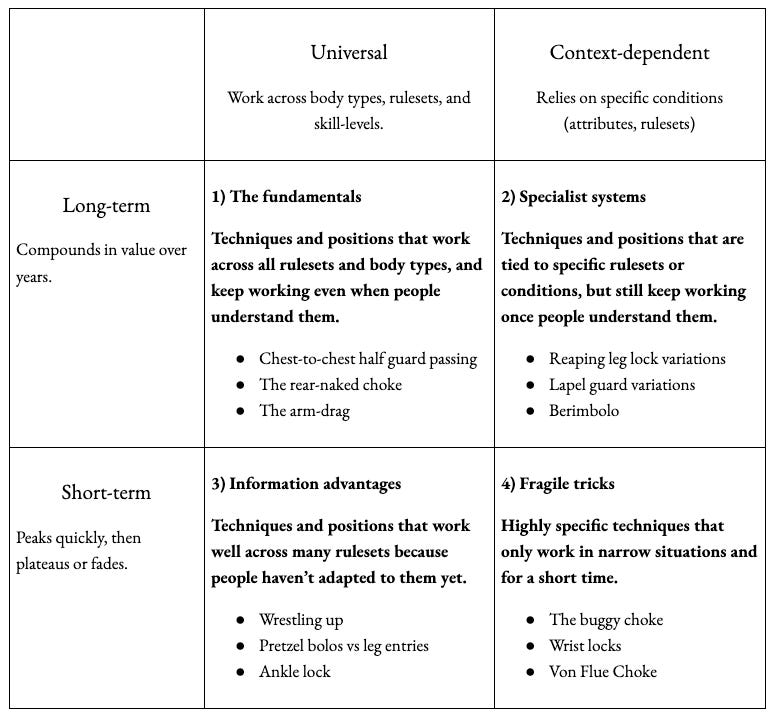
Quadrant 1: The fundamentals
These are techniques that continue to work even after people understand exactly how they work. As far as I’m concerned, your entire game should be built on top of these. You could even choose your tactics the same way.
Dorian Olivarez is a good example of an athlete whose style is built on time-tested fundamentals. Even when it’s time to attack, he does so with the rear-naked choke while actively avoiding leg locks.
Quadrant 2: Specialist systems
These techniques work well over the long term, but only within specific rule sets or contexts. For example, reaping leg lock variations are likely to remain part of the sport for years, but many rulesets still restrict certain reaping variations.
Quadrant 3: Information advantages
These are techniques and strategies that work across many rulesets but aren’t defensible in the long run. They rely on unfamiliarity.
This is where counter-meta approaches belong. They give you a temporary edge, but that edge shrinks once your opponent understands what you’re doing. For me, wrestling up is a good example. When I first started using it, people were genuinely surprised. Now, it’s much harder to land.
Quadrant 4: Fragile tricks
These are highly context-dependent but also have a very short shelf life. Not just in the ruleset from which they emerged, but in the scenarios where they’re applicable. If you build a game on these, your jiu-jitsu will be fragile.
They only work in narrow situations, and often only under specific rulesets or against specific opponents. If you build a game around them, it will be fragile.
Many of these techniques also require you to give up something fundamental in order to attempt the trick. For example, to attack the buggy choke, you have to allow your guard to be passed. You may gain a surprise submission, but you’re trading a strong position for a low-probability outcome.
***
Some caveats
1. Techniques can move between quadrants
Now, go easy on me here; this is still very much a first draft of a framework I’ve been thinking about for a long time.
It’s important to note that techniques can move between quadrants over time. But by watching how they shift, you also learn a lot about what makes techniques last.
For example, ankle locks currently sit in Quadrant 3 as an information advantage. But there’s every chance that, as athletes like Mateusz Szczeciński build more position-based systems around them, they could settle into Quadrant 2 as a specialist system.

2. Ruleset changes can move techniques
If rulesets changed to favour submission hunters like Szczeciński, and people understood what he was doing and still couldn’t stop it, ankle locks might even shift into Quadrant 1 and become part of the foundations.
3. Hyper-specialised techniques can become more universal
The same thing can happen in the other direction. Highly specialised techniques like the berimbolo, which I’ve placed in Quadrant 2 because it was essentially invented for IBJJF Gi, are becoming more generalised. Athletes like Lachlan Giles and especially Levi Jones-Leary are finding ways to use it effectively in No-Gi.
See how this works? The quadrants aren’t set in stone. You might disagree with where I’ve placed certain techniques, and that’s fine, I’d actually love to hear where you’d put them instead. The point of the framework isn’t to be definitive, but to make it easier to think about why some techniques endure while others fade.
Final thoughts
I’ll return to the quote we opened with, which captures the tension at the heart of the last two essays.
“For the perishable, every additional day in existence implies a shorter remaining life expectancy. For the non-perishable, every additional day may imply a longer life expectancy.”
Antifragile, Nassim Nicholas Taleb
For perishable things, every extra day means less time left. In that sense, time is a constraint. It’s the pressure we train under, the reason we have to choose carefully what we spend our hours on.*
But for non-perishable things, like techniques, time works in the opposite direction. Survival becomes evidence. What lasts is more likely to keep lasting.
Seen this way, time isn’t just something we work against in training. It’s also the best tool we have for judging what deserves that training in the first place. Techniques that survive across opponents, rulesets and eras tend to be the ones doing the real work.
Learning how to use time as a filter, not just as a limit, is one of the simplest ways to make better decisions about what to build your game on.
*P.S last week’s essay is a very nice companion piece to this one; here’s the link if you’d like to read.

That’s all from me today. Hope you all have a great weekend!
This is some of the best written content on jiu-jitsu that I’ve come across. I really appreciate where your mind is going in these posts and the thoughtful approach. I look forward to seeing what’s next! Thank you!!!
Did you mean ashi garami instead of sankaku? Sankaku is triangle, so mounted and guard triangles. Maybe terminology changed lately, I'm only loosely connected to the jiujitsu scene.
Speaking of the triangle, recent Combat Jiu Jitsus have been dominated by triangle from guard. A long time ago, Eddie Bravo speculated that if we reintroduced strikes on the ground to jiujitsu all of the fundamental techniques from old school jiujitsu would come back, and he was right. When striking makes top of guard strong, triangles become strong again as a counter strategy.
Also, triangles are incredibly lindy! They're such a strong controlling position that even in youth judo where chokes are not allowed competitors often use an unlocked triangle as a turnover and pinning technique