
How the Lindy Effect changed the way I think about BJJ
An antidote to recency bias for BJJ practitioners who want to build a jiu-jitsu game that stands the test of time.


To some extent, we’re all hardwired to be drawn to things that are shiny and new - especially in combat sports. This ‘Recency bias’ is the human brain’s tendency to assign higher importance to the most recent information or experiences, often at the expense of long-term historical information.
The same way that MMA fans will write off a legendary fighter’s entire legacy if they’re coming off a recent knockout loss, jiu-jitsu practitioners will leave the fundamentals by the wayside for the latest niche leg entanglement they got from a YouTube short.
Walk into the majority of jiu-jitsu gyms, and it’s more likely that the latest viral technique on Instagram is being drilled at open mats, rather than the fundamentals that have worked since the sport of jiu-jitsu was in its infancy.
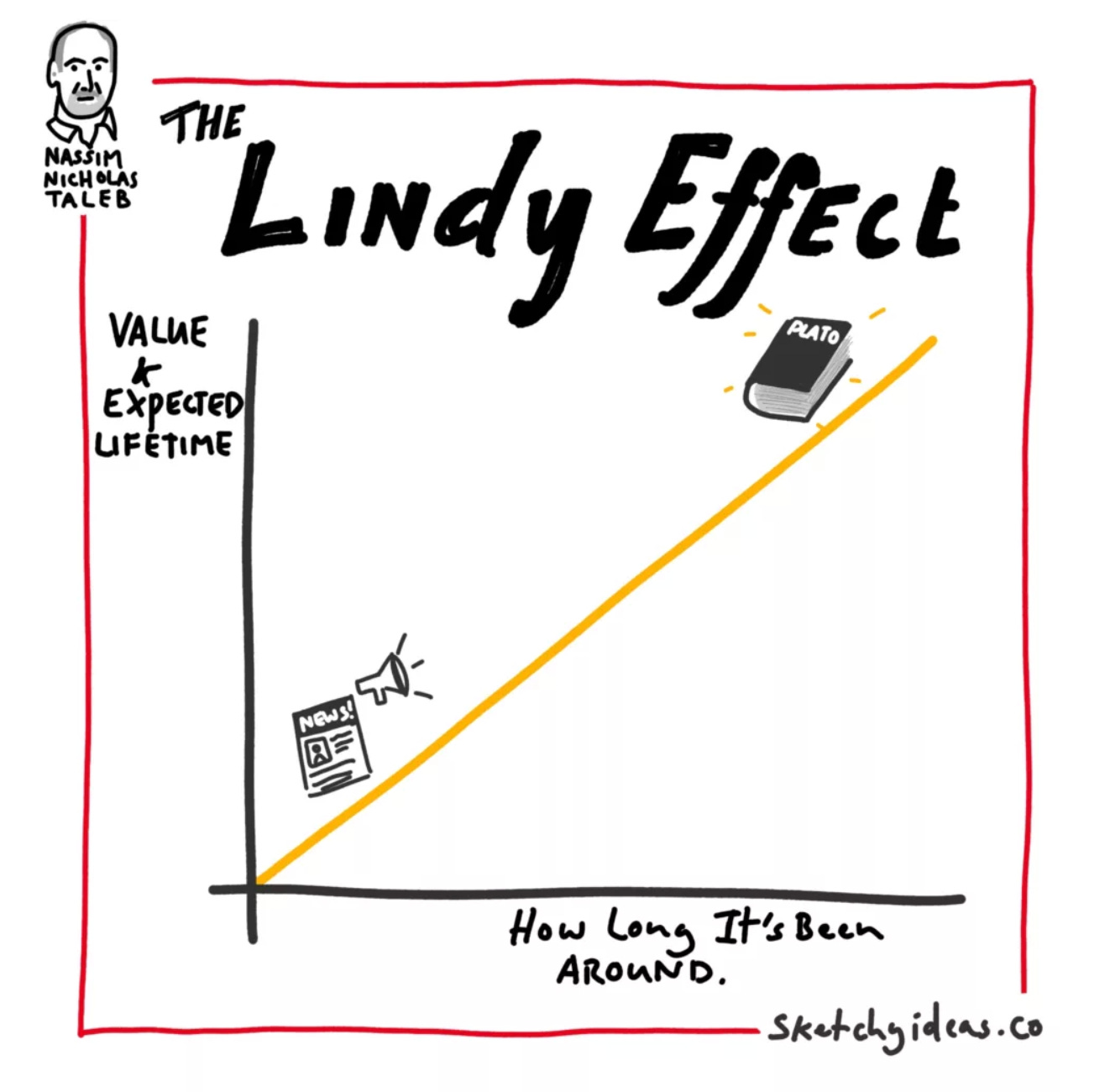
If there is an antidote to Recency bias, it’s probably the idea of the Lindy Effect. It’s the idea that, for non-perishable things (things that don’t go mouldy or curdle), such as books, ideas, survival is the best predictor of future success.
In other words, if an idea has lasted ten years, the Lindy Effect would suggest it will probably last another fifty. While recency bias is a preference for what is new, the Lindy effect shows the power of what has lasted.
This essay is about how you can use the Lindy Effect as a heuristic to overcome recency bias and realise the value of diving deeper into techniques and positions in jiu-jitsu that have stood the test of time.
Where did the Lindy Effect come from?
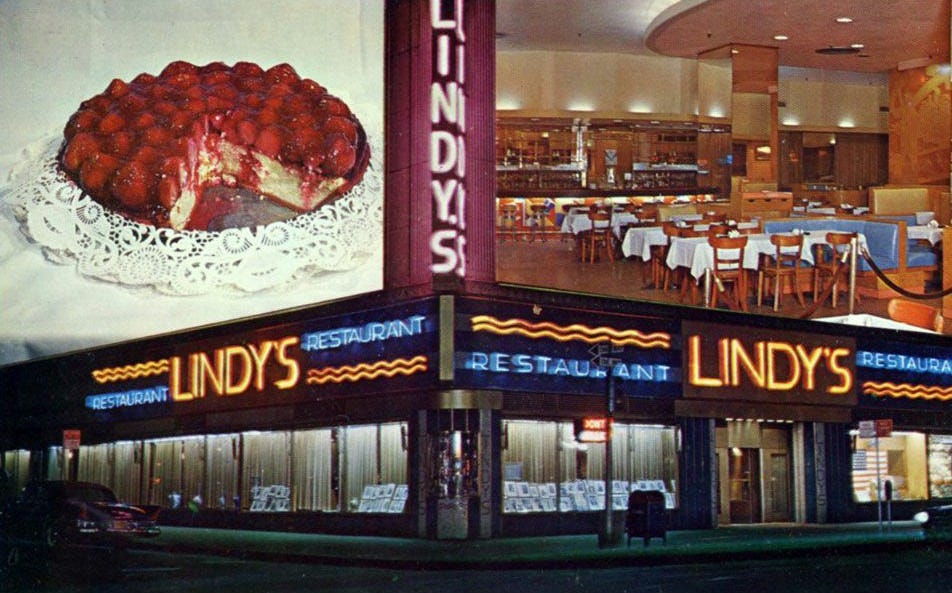
One thing I love about the Lindy effect is that it didn’t emerge from academia, but from people gossiping in a deli called ‘Lindy’s’ in New York.
Actors who frequented the diner would gossip about the nearby Broadway shows, and realised that a Broadway show’s future life expectancy would depend on how long it had already run. For example, if a show ran 200 days, the actors would bet that it would run for 200 more days.
Nassim Nicholas Taleb then coined the term ‘Lindy Effect’ in his book ‘Antifragile: Things that gain from disorder.’ (Fantastic book by the way). Taleb tells the story of Lindy’s Diner, but also expanded the list of things that were ‘Lindy-compatible’ from Broadway shows to almost anything that could be considered non-perishable;
“Only the nonperishable can be Lindy-compatible. When it comes to ideas, books, technologies, procedures, institutions, political systems, there is no intrinsic ageing and perishability. A physical copy of War and Peace can age (particularly when the publisher cuts corners to save 20 cents on paper for a $50 book); the book itself as an idea doesn’t.”
Like the physical copy of ‘War and Peace’, we are not Lindy-compatible. Without getting too gloomy, we obviously age and our time on the mats is limited - making what techniques we choose to spend our training time on even more important.
However, the non-perishable ‘book as an idea’ has a lifespan that increases for each extra day it’s in use. The jiu-jitsu equivalent is a set of techniques, knowledge, and know-how passed down through generations of grapplers.
So the real value of the Lindy Effect for a jiu-jitsu practitioner is using it as a mental model to identify which techniques are Lindy-compatible (those that will work for a really long time) and which aren’t (temporary fads that quickly fade).
BRIEF SIDE NOTE: Ironically, the way the Lindy Effect has grown and sustained over time is itself a perfect example of the Lindy effect. In fact, there are even some reports that the Lindy ‘deli’ where the idea was born has outlasted other restaurants in the same area.
The more you think about the Lindy Effect, the more it changes the way you look at lots of things.
For example, I used to think that older music from the 60s & 70s was when music peaked, but is it just that I’m listening to the cream of the crop, since time has eliminated the bad and mediocre songs from that era?
How to use The Lindy Effect for jiu-jitsu analysis
Like actors at the Lindy Deli making bets on how long Broadway shows would run based on how long they had already run, we can use the Lindy effect to examine which new techniques are more likely to withstand the test of time and which are cheap tricks. That is its primary function as a mental model: to separate temporary techniques from what will last.
That’s why the Lindy Effect is baked into a 2x2 framework I use to assess the potential longevity of new techniques and positions entering the BJJ Meta, which I call the Longevity x Universality Matrix.
I use this 2x2 to weigh techniques along two axes: how long they have lasted (which is really a proxy for how Lindy-compatible they are) and how broad their application is across rule sets and scenarios.

Focus on what does not change
“I very frequently get the question: ‘What’s going to change in the next 10 years?’ And that is a very interesting question; it’s a very common one. I almost never get the question: ‘What’s not going to change in the next 10 years?’ And I submit to you that that second question is actually the more important of the two.”
Jeff Bezos
The first way to apply the Lindy Effect is to study the things that don’t change as much as you study the things that do.
Just to be clear, there’s definitely a lot of value in studying what’s new in the BJJ meta - but if you study that alone, all you’re really observing is change. There’s no way to separate the wheat from the chaff; what works today from what will continue to work in ten years.
If you add a Lindy lens to your analysis, you’re also studying the techniques and positions that haven’t changed. It’s a great way to work out which of the new trends have solid foundations and which are new but won’t last very long.
Tricks vs Fundamentals
Let’s look at an example with two techniques:
The buggy choke of the early 2020s
Position-based leg lock systems of the late 2010s
The buggy choke worked for a while when it first emerged because no one understood how it worked. But there isn’t really any part of the technique that is built on any positional logic that has stood the test of time. You often have to let someone pass your guard to even attempt it. Buggy Chokes for me are the best examples of short-term tricks that don’t work for long.
By contrast, the position-based leg lock attacks employed by the Danaher Death Squad were novel yet built on time-tested fundamentals. What has made them last so long is the array of leg-lock positions created, such as saddle and outside ashi, which themselves were built on positions like single-leg X and X-guard that had already stood the test of time.
For anyone who’s a real nerd and likes to learn how certain techniques evolved, I wrote a full article about the history and evolution of the DDS leg locks:

Combining the old with the new
That’s why any innovation in jiu-jitsu will usually be a combination of the old and new. I like to think of it as a new way of doing something bolted onto a lindy-compatible base that has been time-tested.
Take Gordon Ryan, for example. His style has absorbed many of the sport’s most disruptive innovations, especially in leg locks, yet the cornerstone of his game in recent years has been old-school fundamentals like chest-to-chest half-guard passing.
While there is plenty in his game that is ‘new’, Ryan builds it all on a foundation of positions that have never stopped working. Half-guard passing passes the Lindy test, as it has worked at the highest level since the earliest jiu-jitsu competitions and remains the preference of the sport’s best No-Gi practitioner today.
Focusing on techniques that have proven effective for decades is one of the best ways to future-proof your game. It’ll also help you distinguish between the Lindy-compatible fundamentals (a great foundation for your game) and what you can build on top (new tactics and techniques).
Thanks for reading!
I hope this article showed how powerful The Lindy Effect can be to analyse jiu-jitsu trends and decide what is temporary and what is worth your training time. That’s all from me today. Thanks again for reading, and have an amazing week when it comes.
Thanks for putting out this article. I've been pondering the Lindy Effect in regards to grappling for a bit. I started out in MMA around 2007 and continued grappling for 4 or 5 years before taking a 13yr hiatus (pursuing other sports) and starting up again at the start of 2024.
The game had changed a LOT. I found a lot of 'techniques' didn't work like they used to. Answers had been created for the questions.
What hadn't changed are the underlying 'concepts' and human anatomy. It seems to me that games based on the underlying 'concepts' of grappling are going to be infinitely more Lindy than games built on 'tricks'.
Anatomy -> Concepts -> Techniques -> Tricks
Thank Mo.
I mentioned this to our mutual friend Dan Strauss, when we was posting pics of all the grappling statues in Rome. He was listing off the techniques being depicted and how we still use them today. I said that this was because grappling is based on anatomy and the anatomy hasn't changed. The underlying principles are consistent.