
5 teaching ideas I learned from studying Lachlan Giles and John Danaher that changed how I coach
What I've learnt from from 7 years of coaching BJJ and hundreds of hours watching Lachlan Giles and John Danaher teach BJJ.


I’m a big believer that teaching jiu-jitsu improves your own jiu-jitsu.
Teaching is the process of turning your tacit knowledge - rooted in your reflexes, intuition, and combat experience - into something you can explain to another person. Much of what we do when we roll exists below the level of conscious thought, and that’s why, sometimes, our A-Game is the hardest to articulate.
As a competitor, I spent more time in Headquarters than any other position. Yet when I first started teaching it, I struggled to explain how the position actually worked. It took years of explaining the position and watching where my students struggled to boil down what I had been doing on autopilot to a couple of core details.
Teaching is the act of reverse-engineering your intuition until it unravels into something someone with less experience can understand. I’ve been teaching jiu-jitsu since I was 19, and have been teaching every week since we emerged from COVID. Not only do I spend a lot of time coaching, but also studying other coaches.
Lachlan Giles and John Danaher are by far my greatest influences. I’ve followed Giles since his early days on his first Absolute MMA St. Kilda channel, and now spend A LOT of time on his online platform Submeta. Danaher’s ‘Enter the System’ series has shaped the way I approach so many positions, but currently I spend a lot of time watching his instructionals aimed at older athletes because the fundamentals he teaches there work for every body type.
This essay is five tips I’ve learned over the years from my own coaching and from observing hundreds of hours of John Danaher and Lachlan Giles teaching.
1. Start with your students and work backwards
If you don’t get this one right, everything else you read in this essay will be useless.
Long before you start scouring YouTube or, in my case, Danaher and Giles instructional videos, your focus should start on your students. This might seem really obvious, but you’d be surprised how many coaches turn up to a session with an instructional they’ve memorised and run through it without thinking about whether it’s useful for their students.
I’ve taught BJJ at five different gyms, and every room you walk into has its own unique culture. The overall level of experience can vary just as much. If you don’t pay attention to your students, especially at a new gym, it’s easy to spend time on techniques that aren’t relevant to the people in the room.
Rather than teaching coaching as an exercise in memorising instructions, be more student-oriented. Focus your attention on them and work backwards. There are two main ways I pay close attention to my students.
During classes
If you’re paying attention to your students during classes, you can quickly see where they’re struggling and adjust the constraints or instructions accordingly. Sometimes the smallest changes make the biggest difference. Giving students more time to work through a problem, or covering four techniques instead of the eight you originally planned, can dramatically improve how much they retain.
The same principle applies: if the room is more advanced than you expected, you can adjust your plans and raise the level of the techniques accordingly.
In-between sessions
For coaches who teach in blocks, paying attention to the specific mistakes your students make and noting them down can dramatically improve the relevance of your instruction when you return to the topic. It means you can tailor future sessions around the problems students are actually encountering rather than the ones you assume they’re having.
I noticed this while teaching the same Headquarters passing at two different gyms in different parts of the country. Despite there being no crossover between the groups, students consistently ran into the same problems: whenever they tried to pin the bottom leg, they would load their hips onto their opponents’ butterfly hook - immediately getting swept. After each session, I’d note this common pitfall so I could draw my students’ attention to it the next time I taught Headquarters.
By the time the next session came around, I already knew where students were likely to struggle and could spend more time addressing those areas. Every time I do this, the coaching becomes hyper-relevant because it is built around real problems my students face rather than hypothetical ones I dreamed up.
Once you’ve collected that information, it becomes useful in another way, which brings us to the next tip.
2. Show it wrong, then show it right
I watch a lot of Lachlan Giles and John Danaher before coaching and realised that while their styles are different, they both use one teaching technique repeatedly:
They show their students how not to do it, and then they show the right way.
Once you’ve collected the common mistakes mentioned in the previous tip, make a note of them. Then, in the next class, use them to demonstrate how not to do it. For example:
“If I do [insert the common error you’ve observed], then this will happen, and I will fail.
But if I change and do [insert adjustment/detail], I will succeed.”
Ideas like ‘discrimination learning’ suggest that the human brain learns through contrast. By seeing a common mistake and the correct movement side by side, students get a clearer understanding of the details that matter.
I’ve found this in my own coaching. When I revisit a mistake that repeatedly appeared in the previous session and frame it as a common pitfall to avoid, students not only make the error less often but also seem to remember the correct movement more effectively than if I had shown the ideal version on its own.
3. Keep it concrete
Anyone who’s read my work will know I’m mildly obsessed with the Curse of Knowledge: the idea that, as we become more knowledgeable in a domain, it becomes harder to remember what it was like not to know it.
When we first start learning, we tend to cling to concrete specifics because they’re easy to visualise. In BJJ, that often means knowing exactly where to place a grip or position a limb.
As we improve, our understanding becomes more abstract. Rather than seeing individual techniques in isolation, we begin to recognise broader patterns. Instead of thinking about a specific guard pass, we start thinking in terms of concepts like inside position.
The challenge for coaches is translating those abstract concepts back into language that beginners can understand. I can remember one coach who became worse at coaching as he improved at jiu-jitsu, precisely because his teaching became more abstract. While his students just wanted to learn guard retention, he was lost in a long analogy about how your guard should be like a castle wall against a never-ending sea of tidal waves (true story).
One way around this is to use clear physical cues that help students orient their body in relation to their opponent. For example:
Chest-to-chest
Head over hips
Chest-to-back
C Grip, V grip, S grip
You’ll notice that, as well as being highly concrete, these terms give students a clear objective and a reference point they can immediately understand.
It’s the difference between telling someone to secure a cross-face and an underhook and explaining that the goal is to get chest-to-chest with their opponent. Terms such as half guard, underhook, and seatbelt are useful shorthand once you understand them, but physical cues provide something more tangible. They connect the technique to a position the student can see and feel, while giving them an objective to work towards.
This is one reason I think so many of Danaher’s students, past and present, have a very similar coaching style. Whether it’s Gordon Ryan, Garry Tonon, or Giancarlo Bodoni, they all teach using extremely clear and concrete physical cues.
4. Don’t overload the details
Arguably the most important part of instruction is separating the vital details from meaningless minutiae.
For any coach (and for me as a writer), it means constantly fighting against what cognitive psychologists call ‘additive bias’: the psychological urge to solve problems by adding new elements rather than removing existing ones. Research suggests that humans love to add things. Even when simplification would be more effective, people are far more likely to look for additive solutions than subtractive ones.
Everyone who comes to your class has extremely limited cognitive bandwidth. While jiu-jitsu might fill a large part of your life, it’s likely only a small slice of theirs. If someone’s working a 9-5, juggling work with kids, your job as a coach is not to overload them with details - but to give them the most important ones.
Something I’ve noticed John Danaher and Lachlan Giles handle this is by providing general rules from a position. These are often called heuristics: simple rules of thumb that are true most of the time.
For example, a useful heuristic for escaping back control is that the battle is won when you can get your shoulders past the centre line of your opponent’s chest. It’s effective because it simplifies a complex situation into a clear objective. Rather than forcing students to consider dozens of possibilities, it narrows their focus and gives them direction.
It’s also highly concrete. Instead of asking a beginner to think about something abstract like inside position, you’re giving them a physical cue they can recognise across a wide range of situations.
5. Connect everything to the big ‘why’
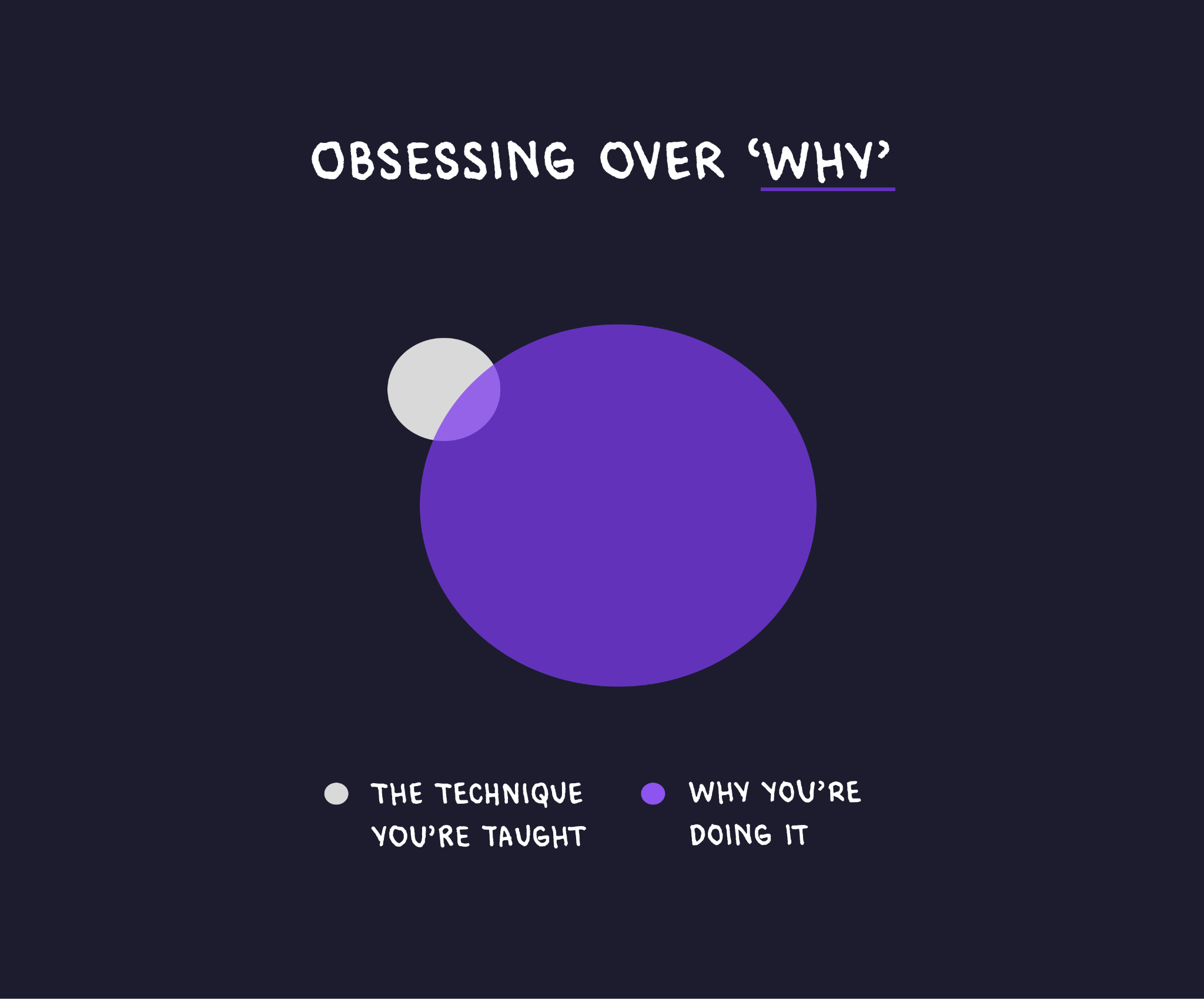
If I were to pick one thing that would make the biggest improvement to most jiu-jitsu coaches, it would be connecting everything they teach to a larger ‘why’.
So many jiu-jitsu instructors teach students to do things without telling them why they’re doing them. The result is a jumbled assortment of details with no larger context or reason to group them together.
When teaching back control, some coaches will spend a lot of time explaining how to secure your hooks and seatbelt without ever explaining their purpose. Hooks and the seatbelt are simply two ways of controlling your opponent’s hips and shoulders. If your opponent can free either of those areas and begin to move, their chances of escaping increase dramatically.
Rather than simply showing students how to do something, one of the biggest improvements you can make as a coach is to ask yourself:
“Have I explained why they should be doing this? Do I even know why they should be doing this?”
If you don’t understand the purpose behind a technique, it’s difficult to explain it in a way that students will remember. Any BJJ position contains an overwhelming number of details, and details are much easier to remember when they’re connected to a broader idea.
For a moment, try to remember these acronyms:
XJZ, QPT, VNK, SWP, CMF, WZY
Now try to remember these:
FBI, USA, BMW, NASA, SUV
The second group is probably much easier to recall. Psychologists refer to this as chunking: the process of grouping individual pieces of information into larger, more meaningful units. Familiar acronyms allow the brain to compress and retrieve information more efficiently, helping us work around the limits of working memory.
The same principle applies to jiu-jitsu. Every position contains dozens of details, but those details become easier to understand and remember when they’re organised around a larger purpose. A student is far more likely to remember a cross-face and an underhook if they understand that both serve the broader goal of pinning your opponent’s shoulders to the mat.
Never forget the ‘why’. This is also something which separated John Danaher and Lachlan Giles as coaches for me whenever I was watching instructionals. Everything they taught laddered up to a clear ‘why’, which meant I could take the moves they were teaching and train them with more purpose.
6. Get out of the way
The last thing, and arguably the hardest for a coach, is to know when to get out of the way.
Being able to take this step means making the transition from an instructor - a person who tells others to do things - to a coach - someone who knows exactly what information to provide to guide someone during their progression, without telling them ‘this is the way you must do it’.
The best coaches live in the Goldilocks zone, providing helpful information that serves as creative constraints, forcing students into more productive exploration. In this sense, ‘rules’ are only there to shrink down the solution space so students can experiment and find their own solutions.
The best coaches walk a tightrope between:
Structure: the parts of jiu-jitsu that don’t change very often.
These are the fundamentals that make it effective: techniques built on solid principles and a clear understanding of why they work. These form the foundation on which everything else rests. Admittedly, most of this essay has been about how to articulate the structure of jiu-jitsu.
Freedom: the parts of jiu-jitsu that benefit from change.
Once your students have the information, you need to give them space to build their own technical expression and to apply those same fundamentals in their own way. Any gym will be made up of a myriad of people with different personalities, body types and attributes.
If you impose your own style too heavily, you risk suppressing individuality and creating a room full of people whose jiu-jitsu looks the same. Great coaches give students structure to solve a problem while leaving enough freedom for them to develop their own game.
The best coaches I’ve ever had were prescriptive about principles but completely open about execution. They gave us a handful of rules that couldn’t be broken, and complete freedom outside of them.
And that’s why the best coaches know when to provide information, and when to get out of the way.
I was exposed to teachers who just want to roll, so they just teach a drill or two and then, just roll. I also was expised to teachers who actually want their students to learn and get better. Those classes tend to be packed with students.
From your writing, it shows that you are dedicated to your students and I applaud you for that. And that’s the reason I come back to your aubstack.
That lens changes how you view things considerably. I wish more teachers were less concerned with themselves and were more attuned to their students.
Really cool approach. Danaher and Lachlan both have this way of breaking things down that forces you to think differently. Did you notice a difference depending on belt level?